Terraform Coalesce vs Try: Error Handling with Practical Examples
Discover how to effectively handle errors with Terraform Coalesce vs Try. Learn through practical examples and improve your infrastructure as code skills.
Kashyap Merai / / terraform · 5 min read
Terraform is an open-source infrastructure as a code (IaC) to define and provision the infrastructure using the simple configuration file.
You can write the whole infrastructure as code and run the terraform plan and terraform apply to provision it. Let’s explore the Terraform Coalesce vs Try function with a practical example.
Understanding Terraform Functions
Terraform provides the built-in function to operate on various data types. They help to dynamically manipulate and transform the data to manage the configuration easily.
Commonly Used Terraform Functions
Commonly used function in Terraform:
| Function | Usage |
|---|---|
lookup | Retrieve the value from a map with a given key. |
merge | Combine multiple maps into a single map. |
concate | Join multiple lists into one. |
Terraform Coalesce vs Try: Common Function
Kickstart Your DevOps Career
Get the free Notion training board that shows you exactly what to learn, in what order, with zero guesswork.
Coalesce Function
What is the coalesce Function?
The coalesce function used to return the first non-null argument from the provided list of arguments. It is useful when you define the value for the multiple optional variables or handle the missing value in the data source.
Syntax - Coalesce Function
coalesce(val1, val2, ...)Example - Coalesce Function
# Define the primary region variable, allowing user input or leaving it null
variable "primary_region" {
  description = "The primary AWS region to use"
  type        = string
  default     = null
}

# Define the default region
variable "default_region" {
  description = "The default AWS region to use if primary region is not set"
  type        = string
  default     = "us-east-1"
}

# Determine the AWS region using the coalesce function
locals {
  aws_region = coalesce(var.primary_region, var.default_region)
}

# Output the selected AWS region
output "selected_region" {
  value = local.aws_region
}
Output - Coalesce Function
selected_region = "us-east-1"In this example, if the user doesn’t define the var.primary_region value, terraform will use the var.default_region and value will be us-east-1.
Use Cases for coalesce
Setting default values for optional variables.
Handle the missing attribute in the data source.
Simplify the conditional logic with a fallback default value.
Limitation of coalesce
It only works with the
stringand can’t handle complex data types.If all arguments are
nullorempty, Terraform will throw an error.Error handling is not implemented.
Free DevOps Learning Board for Absolute Beginners
11 core modules, curated content, and clear action steps - all in one interactive Notion board.
Try Function
The try function evaluates the given expression in order and returns the result of the first expression that does not produce the error.
In Terraform Coalesce vs Try, coalesce function can’t handle the error if all the values are empty. But with the try function it attempts to evaluate the expression and falls back to the default if the expression fails.
Syntax - Try Function
try(expr1, expr2, ...)Example - Try Function
# Define the primary region variable, allowing user input or leaving it null
variable "primary_region" {
  description = "The primary AWS region to use"
  type        = string
  default     = null
}

# Define the default region
variable "default_region" {
  description = "The default AWS region to use if primary region is not set"
  type        = string
  default     = "us-east-1"
}

# Determine the AWS region using the try function
locals {
  aws_region = try(var.primary_region, var.default_region)
}

# Output the selected AWS region
output "selected_region" {
  value = local.aws_region
}
Output - Try Function
selected_region = "us-east-1"Use Cases for try
Handle errors gracefully when encountering unexpected issues.
Exception handles and catches errors during data manipulation.
Limitation of try
The
trythe function can only catch and handle dynamic errors.Can’t handle the error related to the expression such as invalid input or wrong resource reference.
Terraform Coalesce vs Try: Choose the Right Tool
Similarities: Terraform Coalesce vs Try
Both Terraform function coalesce and try allow for fallback to the default value and manage the optional or undefined variable efficiently.
Key Differences: Terraform Coalesce vs Try
Use
coalescefor setting the default values and handling missing data.Use
tryfor error handling and fallback gracefully.
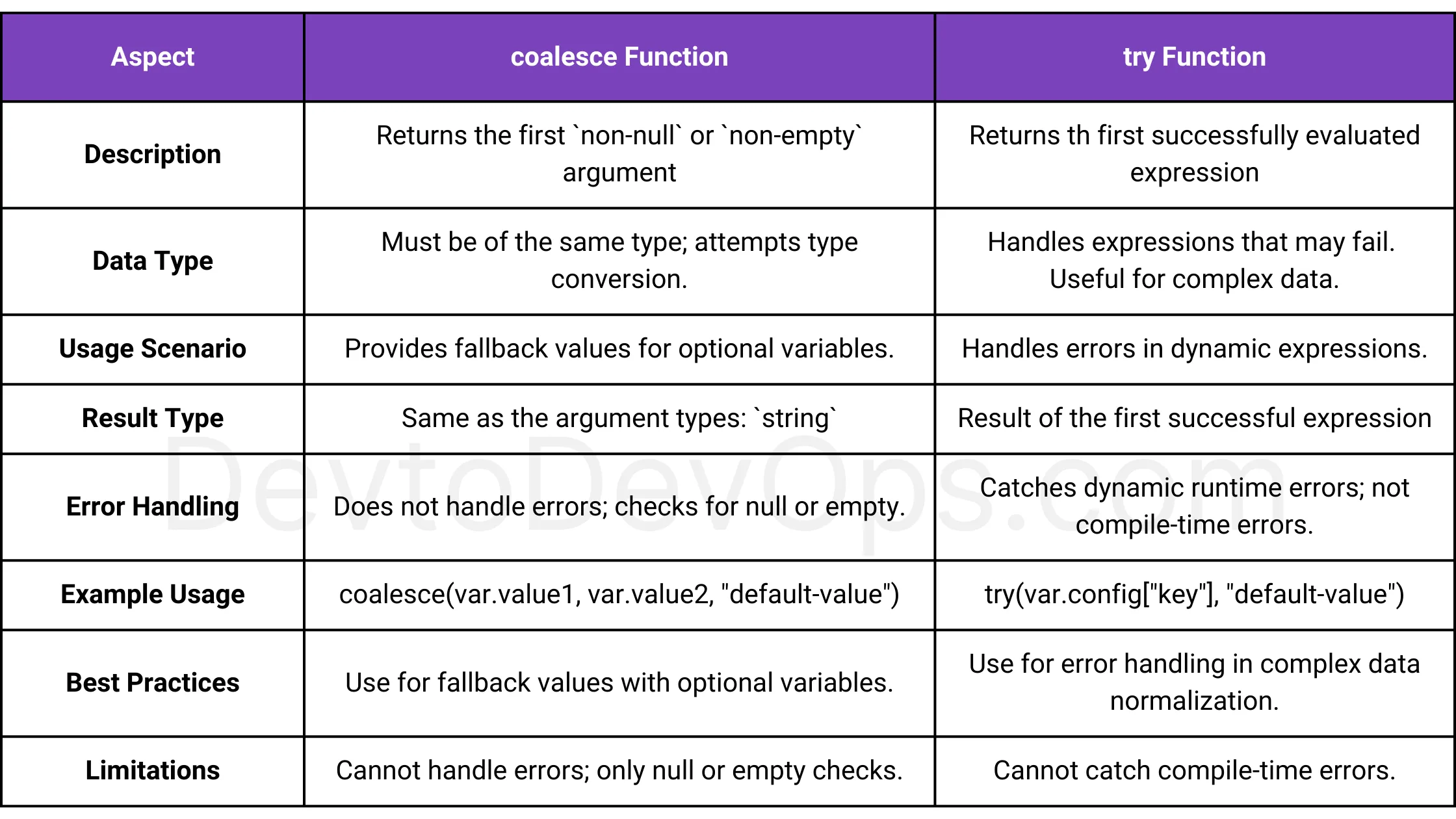
Terraform Coalesce vs Try Comparison
Terraform Coalesce vs Try: Practical Example
Example 1: Default VPC for an EC2 Instance
If you launch an EC2 instance, the VPC might be a variable or module output. Use coalesce to make the valid VPC always available.
variable "vpc_id" {
  type     = string
  default  = "us-east-1"
}

module "vpc" {
  # Output the VPC ID from the VPC module
  outputs {
    vpc_id  = data.aws_vpc.main.id
  }
}

resource "aws_instance" "web_server" {
  # Use coalesce to ensure a VPC ID is always provided
  vpc_id   = coalesce(var.vpc_id, module.vpc.outputs.vpc_id)
}
In this example:
var.vpc_idis default and allows the user to override.coalescechecks thevar.vpc_idfirst and if empty, it used the value from thevpcmodule.Using
coalescemake sure that the EC2 instance has a valid VPC.
Example 2: Handle Missing Tags in Data Sources
Another use case is if you have an AWS S3 bucket with missing tags, you can write below Terraform to handle the missing tags:
data "aws_s3_bucket" "bucket" {
  bucket = "bucket-name"
}

output "bucket_versioning_enabled" {
  value = coalesce(data.aws_s3_bucket.bucket.versioning.enabled, "false")
}
Using the coalesce ensure that it will keep the bucket version as it is but if the value is missing use the default value false
Example 3: Use Try to manage Error Gracefully
variable "optional" {
  default = null
}

output "try_example" {
  value = try(var.optional["nonexistent_key"], "fallback-value")
}
Terraform Coalesce vs Try: Best Practices
Use
coalescewith a combination of null checks for error handling.Ensure that expression in
coalescewill return a non-null value first.Use
tryto handle complex logic and take action based on success or failure.tryhandle the errors but using it in critical applications can be hard to understand and maintain. Don’t overuse it.
Conclusion
We’ve discussed the common Terraform built-in functions such as merge, lookup, and concate the detailed usage and comparison of Terraform Coalesce vs Try.
Remember use coalesce as your default for handling optional values, and try to handle runtime values where you can face unexpected cases.

Kashyap Merai, a Certified Solution Architect and Public Cloud Specialist with over 8 years in IT. He helped startups in Real Estate, Media Streaming, and On-Demand industries launch successful public cloud projects.
Passionate about Space, Science, and Computers. He also mentors aspiring cloud engineers, shaping the industry's future.
Connect with him on LinkedIn to stay updated on cloud innovations.